Guide
Why do I keep scrolling on my phone?
You went to check one thing. You checked it. Your thumb kept going.
The short answer
There is no single explanation for every scroll. You might be waiting, enjoying what you found, putting off a reply, or reaching for your phone without a plan. Cohesive's approach is to start with one occasion: what were you doing, and what was happening around it? That gives you something concrete to examine without deciding in advance that the phone is the problem.
You can recognise the moment without having an explanation for it. A scrolling total does not tell you what you opened the phone for, what happened next, or whether you would choose that same evening again.
This guide presents Cohesive’s approach to reflection. It is not a scientific explanation of all phone use, a diagnosis, or evidence that using the app reduces screen time.
What can you learn from one occasion?
You can describe what actually happened before deciding what it means.
Compare these two descriptions:
- “Instagram, waiting for my friend to arrive.”
- “Instagram, a message from my friend is still unanswered.”
The app and the time spent could be identical. The circumstances are different. Neither description tells us, on its own, that anything needs fixing.
Why not stop at “it’s dopamine”?
For the question this guide asks, that label leaves the occasion undescribed. It does not tell you which message was waiting or what you wanted to say.
Our preference is to ask about something you can remember. That is a choice about how Cohesive works, not a claim that biology, app design or habits are irrelevant.
What does a short session look like?
The following is an authored example, not a customer story or a recording of an app session. Actual questions depend on what the person says.
| Step | An example |
|---|---|
| Catch the moment | “Looking through Instagram.” |
| Add the circumstance | “I said I would send Ana my CV today.” |
| Choose | Save the catch and stop, or choose to look underneath. |
| One possible question | “What still needs doing before you send it?” |
| The person’s answer | “I haven’t decided how to explain the gap.” |
| A sentence they could choose to keep | “I put off sending my CV while I haven’t settled how to explain the gap.” |
The sentence belongs to the person only when they choose its exact wording and press Keep. They can edit it or keep nothing. A suggestion is not a verdict about them, and this example is not a promise that every session ends in one question.
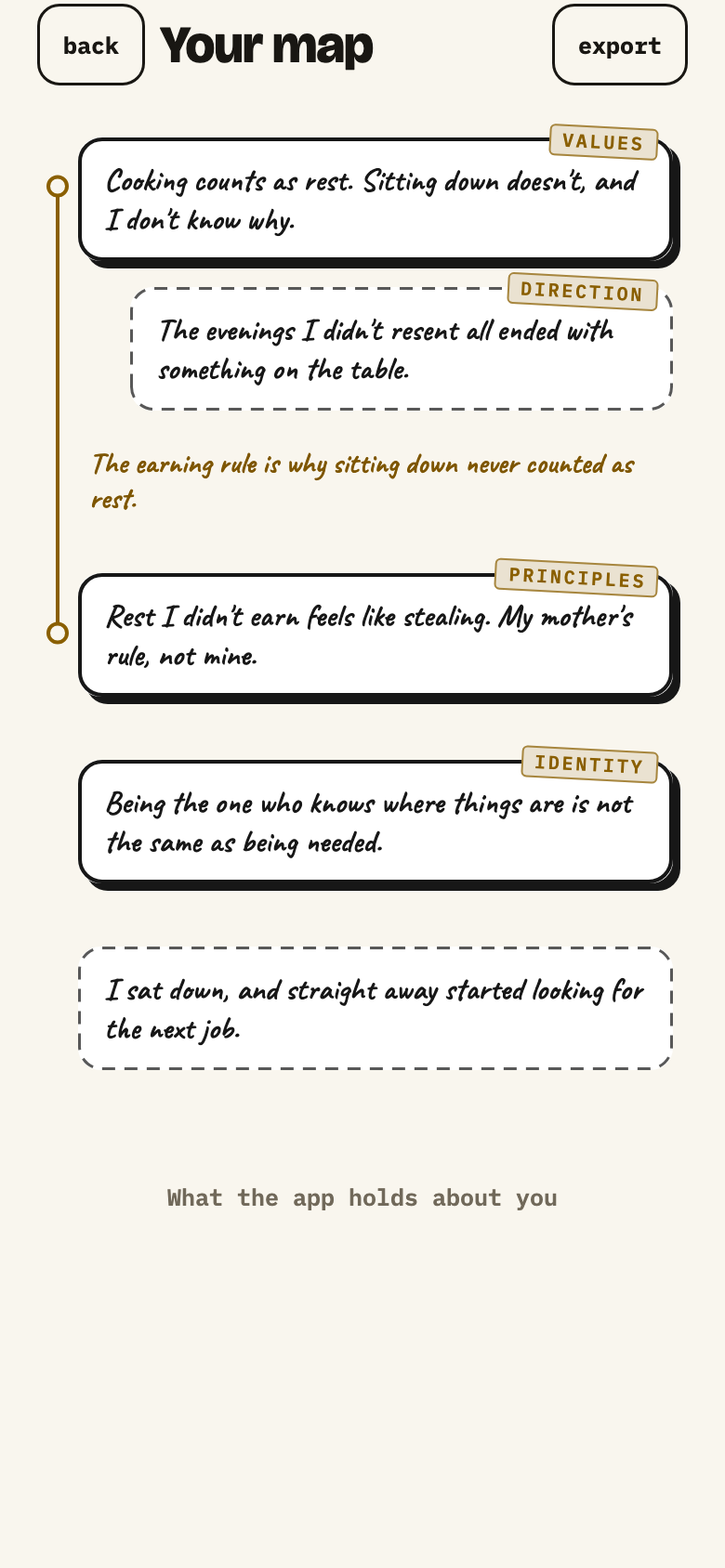
Cohesive calls the sentences a person keeps their life map. It can be read, edited and exported without a paid plan. Catching moments stays free; the first finding is free, and later inquiries require a plan. See the current purchase terms.
What if there is nothing underneath?
You do not have to produce an insight. You may have wanted to watch the video. You may prefer to leave the question alone. Saving a catch without exploring it is a complete use of Cohesive.
Try the example on paper if you prefer. Write the occasion before you write the explanation. What you keep, if anything, is your decision.
When would another tool fit better?
If you already know you want access to an app restricted, an app blocker addresses that request directly. Our comparison pages explain where those tools fit and where Cohesive takes a different approach.
Cohesive supports reflection; it does not diagnose or treat health conditions. A question about symptoms or treatment belongs with a qualified professional.
Correction, 6 September 2026: an earlier version gave an unsupported timing for reaching for a phone and made broad claims about why people scroll. Those claims have been removed. The guide now distinguishes our approach and authored examples from research findings.
Questions people ask
Can this tell me whether I have an addiction?
No. This is an explanation of Cohesive's reflection approach, not a diagnostic assessment. Cohesive does not diagnose or treat health conditions.
Does the amount of time matter?
A duration tells you how long you used something. It does not tell you what you wanted from that time or what else was waiting. This approach asks about that missing context; it does not decide that time limits are unimportant.
Why does it happen more at night?
Start with the particular evening. Were you waiting for someone, following something you enjoyed, or leaving a task unanswered? Those are possibilities to check against your own account, not explanations the app assigns to you.
Can I try this without an app?
Yes. Write what you were doing and what was happening around it. Ask yourself one concrete question about that occasion. Keep a sentence only if it says something you want to keep; stopping with nothing written is also an ending.
Last reviewed: · Written by Alejandro Carbajo